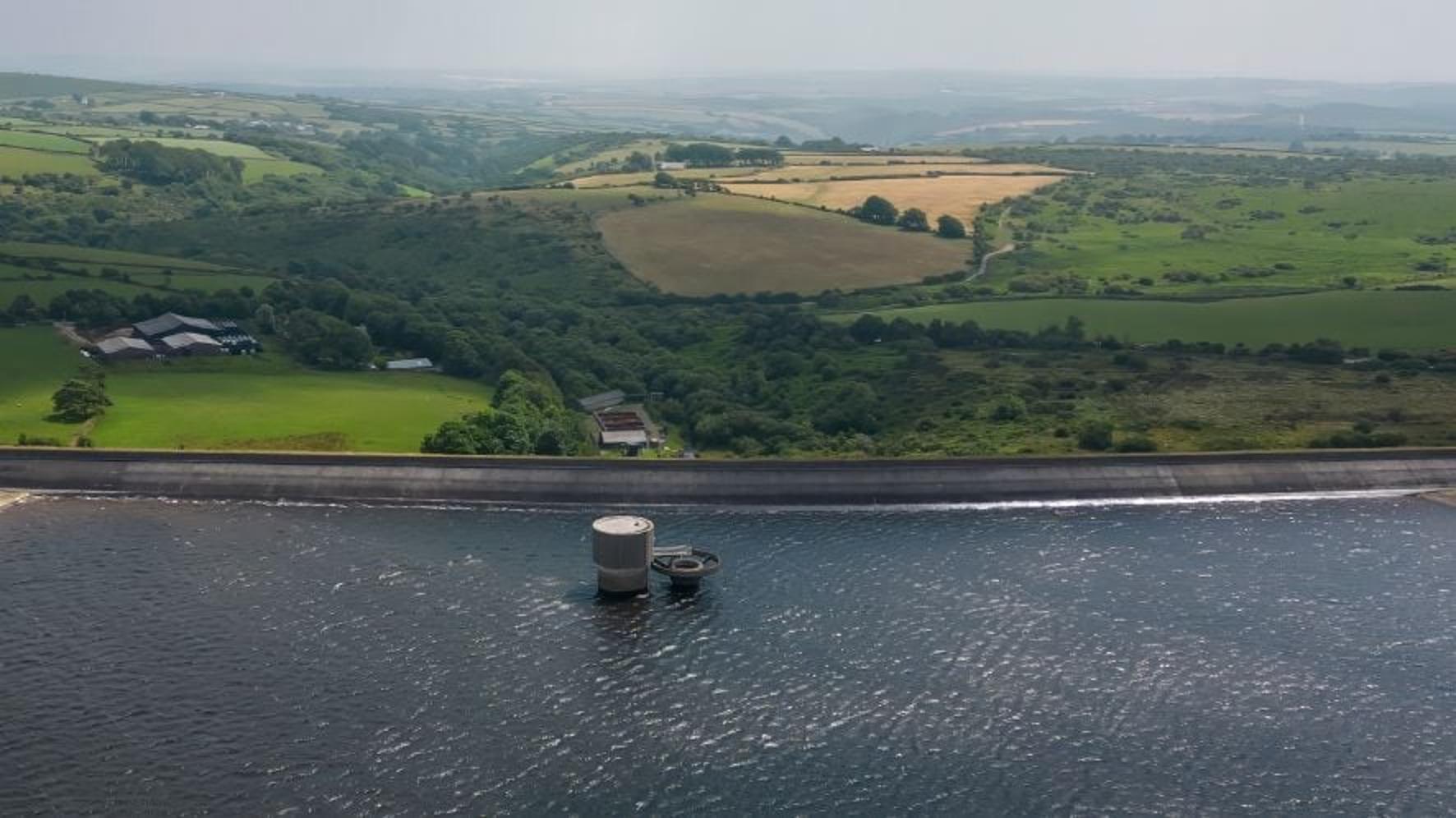
After what has felt like constant rain across the South West so far this year, it’s no surprise that many local reservoirs are full.
Cornwall’s largest reservoir, Colliford, currently sits at 89.9% capacity which is normal due to its size and the location of the catchment.
South West Water’s Senior Water Resources Manager, Paul Merchant, explains more about how this particular reservoir works.
“Colliford is a very large reservoir, holding around 28.5 billion litres of water when full and providing more than 60% of Cornwall’s total storage capacity,” Paul says. “Because of its size and the relatively small catchment that feeds it, Colliford naturally recharges more slowly than some of our other major water sources.”
A reservoir’s catchment is the area of land that drains rainfall into it. A larger catchment means quicker refilling. Compared to the two other major regional reservoirs – Roadford and Wimbleball – Colliford’s catchment is around two and a half times smaller.
Paul explains why Cornwall’s water system is operated in a way which accounts for this: “While it’s always helpful for Colliford to fully recharge over winter, our system is designed so that we don’t rely on that happening every year. Because we know Colliford refills more gradually, our resource planning accounts for this over a multi-year timescale rather than season by season.”
In the past decade, Colliford has reached 100% capacity only twice, however, it has also only dipped below 40% once, and that was during the 2022 drought. “Even at its lowest typical levels, there is still plenty of storage available. That’s why we don’t need Colliford to be full to maintain resilience,” Paul says.
Cornwall’s wider water resource network is built around a diverse system of 12 reservoirs and five river sources. Paul’s team continually balances the use of these resources to account for the way each source responds to weather patterns and customer demand.
“In simple terms, when other sources refill more quickly, we can make greater use of them and ease the demands on Colliford,” Paul explains. “We use Colliford in two ways; by pumping directly into treatment works in east Cornwall, and by releasing water into the River Fowey so it can be abstracted at Restormel Treatment Works and supplied across much of the county.
When river flows are high, Restormel can meet demand directly from the River Fowey. When flows fall, controlled releases from Colliford both support supply and protect the local environment.”
Paul adds that supply is only one side of the equation: “Reducing leakage and helping homes and businesses use water more efficiently are essential parts of our resilience planning.”
Looking up to 50 years ahead
Every five years, South West Water publishes a Water Resources Management Plan, which looks 25 to 50 years into the future. The plan assesses expected demand, including population changes and tourism, alongside how much water the region’s sources can sustainably provide, taking climate change and environmental protections into account. Where there’s a gap, options to maintain resilience are developed. This long-term modelling ensures Cornwall’s supply remains secure.
“Over the last 20 years we’ve repurposed four disused quarries into new reservoirs for Cornwall,” Paul says. “These additions strengthen our resilience and give us even more flexibility to reduce reliance on Colliford and conserve its storage.”
Colliford typically continues to refill well into April, and sometimes May.
“If we see average rainfall for the remainder of winter, we’d expect Colliford to reach above 90% as we head into summer,” Paul confirms, adding: “The key message for customers is that Cornwall’s water resources are managed as a whole system. Colliford being below 100% at this point in the year is completely normal – and fully planned for.”