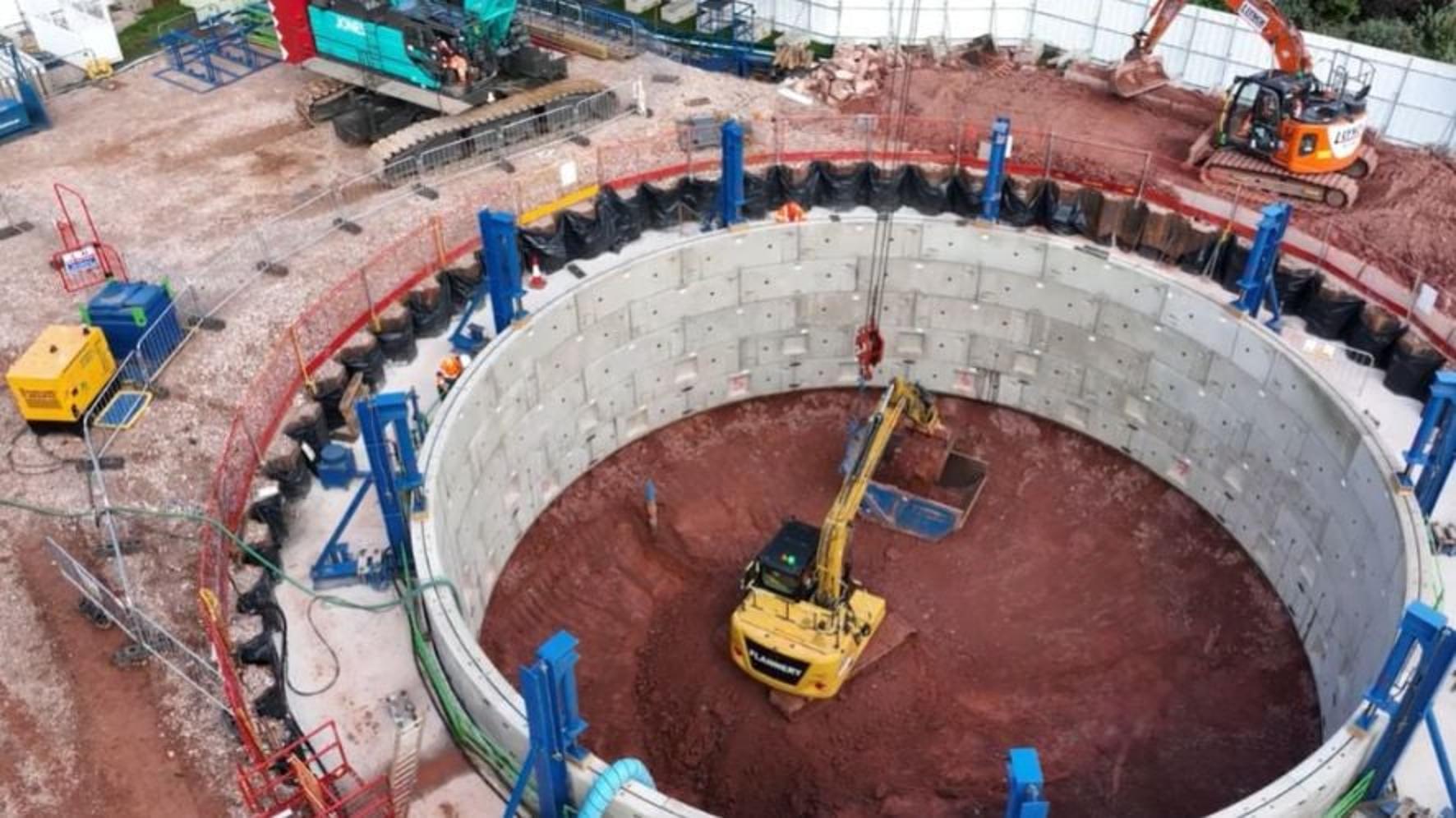
In Dawlish, a major project will help hold around 4.5 million litres of wastewater and rainwater at times of heavy flow, helping to prevent spills from storm overflows.
We’re installing two enormous underground concrete storm tanks in the town. Once work is complete, they’ll be almost undetectable, but they will help to protect water quality in the nearby bathing waters.
This work forms part of our ambitious £760 million Turning the Tide programme to reduce storm overflow use throughout our region.
Why do we have storm overflows?
Storm overflows are like emergency valves on the wastewater network. At times of high flow, the sewers can become overwhelmed. This is usually because heavy rain has added to volume in the system. Overflows operate to prevent waste from backing up into homes and neighbourhoods.
We can’t simply remove storm overflows, because this would make it much more likely that wastewater would spill into people’s homes and neighbourhoods at times of very high flow in the system. Instead, we’re making it much less likely that they’ll be needed through measures like adding more wastewater storage, increasing treatment capacity or keeping surface water out of the system.
In Dawlish, we decided the best solution would combine more stormwater storage with measures to keep surface water out of the system.
Huge tanks for Dawlish
We’ve installed two huge underground wastewater tanks in Dawlish. One is under the Lawns, a green space in the centre of the town, and another is under a car park. Together they will store around 4.5 million litres of wastewater during heavy rainfall (2.2 million litres/2,200m3 at the Lawns and 2.3 million litres/2,300m3 at Sandy Lane).
The tank under the Lawns is being sunk into a hole that took six weeks to dig, with 12,000 tonnes of earth being removed. The tank is 16.5 metres deep and 17.5 metres wide from the inside walls, which are made from 252 specially designed concrete blocks weighing a total of 2,200 tonnes.
This mighty tank will hold wastewater and rainwater until treatment capacity is available at the nearest sewage treatment works. Once construction is complete, the Lawns will be returned to its previous appearance with green space, plants and trees.
Keeping surface water out of the sewers
The tanks are just one part of the plan for Dawlish. We’re also creating separate sewers for surface water from rainfall. Currently, much of the town has older sewers which were designed to mix waste from homes with surface water. In the days before large-scale sewage treatment, this surface water helped to keep waste moving through the system and out into rivers or the sea.
Adding a separate system means that less rainwater will reach pumping stations and sewage treatment works, reducing the likelihood that they will run out of capacity. Along with the storm tanks, this will help to make sure that storm overflows are used a lot less.
Our goal is to reduce spills at each storm overflows to fewer than ten per year by 2040, ten years ahead of the government target. Find out more about our plans for Dawlish and how we’re turning the tide on storm overflows.