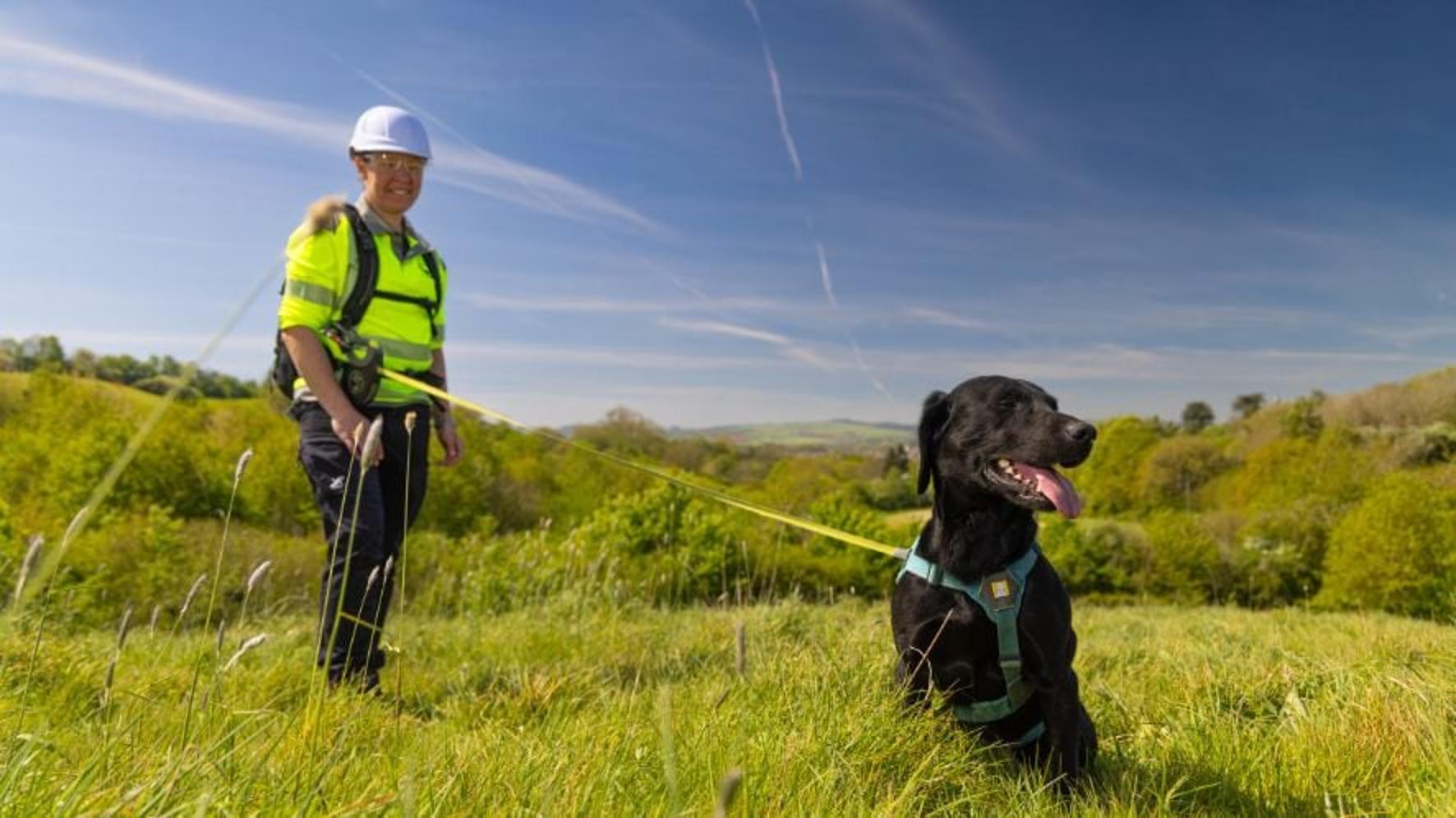
Many of our water pipes cover long distances in rural areas. We use specially-trained dogs to help us find leaks on the network in these remote places.
Why is it harder to find leaks in rural areas?
The devices we use in built-up areas are less effective in the countryside where there’s more distance to cover.
In towns and cities, most leaks are quickly reported to us. (You can do this on our leaks page). We also look for leaks proactively, using acoustic devices to pick up on the sound of pressurised water escaping from a pipe.
We use sniffer dogs in rural areas as a much better solution. The dogs are trained to sniff out chlorine, which is added to drinking water in tiny amounts as an extra protection measure. If the dogs can detect a faint scent of chlorine, it’s probably coming from a leaky pipe.
What are the advantages of using a dog for leak detection?
Dogs can cover a much wider area than a human using acoustic equipment. They find leaks that are hard to spot, including those underground that couldn’t be spotted by the human eye.
At the moment, our sniffer dog is a very special Cocker Spaniel called Tico. She’s formed a special bond with her handler Steph. Together, they walk out looking for leaks a few times a week, throughout the year – subject to the weather, of course!
We also use satellites and drones to spot leaks in isolated spots such as Dartmoor and Exmoor. These innovative devices use technology such as thermal imaging to detect temperature differences that could be due to leaks.
Why do dogs have such a good sense of smell?
Our sense of smell uses olfactory receptors, which are tiny sensors within the nose that detect smells and send a chemical signal to the brain, enabling us to recognise a particular smell or taste.
The average human has five million of these tiny olfactory receptors, but dogs have up to 300 million, depending on the breed of dog. Dogs’ sense of smell is so sensitive that they can smell the hormonal changes that happen when humans are sad, scared or ill.
Dog noses are structured differently to ours, with separate nostrils for breathing in and out, and nostrils that work independently so they can tell whether a smell comes from the left or right. Dogs can sniff up to six times per second, and keep their noses to the ground – giving them an extra advantage in picking up scents.
All this makes dogs perfectly placed to sniff out leaking tap water by the scent of chlorine used to treat the water.
We’re committed to reducing leaks
With climate change and population growth, our water network needs to be more resilient than ever before. This means storing more water, encouraging customers to use water wisely, managing the network efficiently and reducing the volume of water that’s lost to leaks each year.
Every month we find and fix more than 2,000 leaks on the network. Finding and fixing leaks is a 24/7 job, and we’re making real progress in reducing the amount of water lost in this way.
As a customer, you can help by reporting leaks if you notice them, watching out for leaks on your own property and adopting water-saving habits to help keep more water in reserves.
A yummy reward for a good girl
You might be wondering, what’s in this for Tico? Don’t worry, she loves the challenge and exercise. She also always gets a tasty reward for all her hard work. Like any dog after a good walk, she usually snuggles down for a good sleep on the way home!
Find out more about leaks, how to spot one and what to do if you find one on our leaks page.