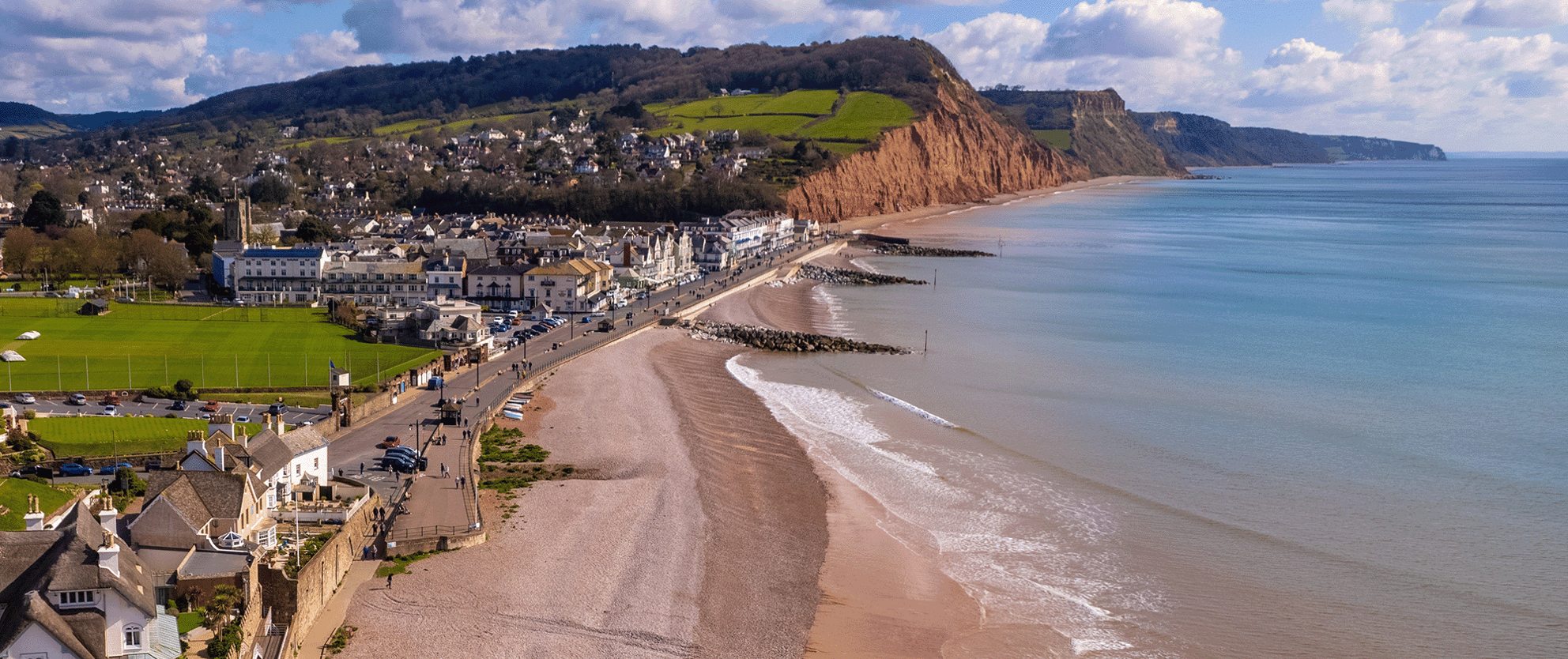
Sidmouth Town
The attractive Victorian resort of Sidmouth lies on the coast about 15 miles from Exeter. The main beach on the town’s seafront is largely made up of hand-sized pebbles above the shoreline. At low tide a strip of rich, red sand is exposed with some interesting rock pools. Sidmouth’s gently sloping beach is backed by a low sea wall, and there are a number of groynes leading into the sea, to minimise beach erosion. Red-hued cliffs flank both sides of the beach.
The town beach has a slipway at the eastern end which gives boats access to the sea. At the western end of the esplanade kayaks and canoes are available for hire.
There is no lifeguard, and swimmers should not swim beyond the marked buoys, as there are strong currents in the offshore breakwaters.
Overflow locations
The map below shows the locations of the storm overflows that have the potential to impact water quality at this bathing water.
The map shows whether or not a storm overflow is currently active, the time and duration of the last spill at that location, and our investment commitments that are specific to that overflow.
Sidmouth Town storm overflow map
Water quality sample results
The graphs below show the significant reduction in harmful bacteria in the Environment Agency’s (EA) water samples since the 1990s. E. coli and Intestinal Enterococci exist in all open water - they are found in human and animal poo, and get into the water via sewage spills, road drainage, agricultural livestock, or wildlife and birds. The EA uses the levels of these bacteria to decide whether to award this beach bathing water status.
Current investment
A new 100,000 litre storm storage tank is being installed at The Ham to increase capacity during heavy rainfall. Extensive sewer rehabilitation has also been completed, including sewer lining, repairs and manhole improvements to reduce groundwater entering the network.
Find out more about the ongoing works in Sidmouth.
4 year overflow spill information
The data shown in the table below is the reported annual total spill number for each overflow which has been identified by the EA for this bathing water.
The assignment of an overflow to the bathing water does not always mean an impact will occur, it can be dependent on a number of factors such as tidal state and weather conditions. Sometimes it has been allocated just for investigation purposes and has no impact at all.
All data collected goes through vigorous quality assurance processes before being included in the counts. Sometimes debris can trigger false spills to be recorded, resulting in potentially higher than actual spill numbers.
Number of spills
| 2025 | 2024 | 2023 | 2022 | |
|---|---|---|---|---|
| The Ham pumping station overflow Low Level, Sidmouth | 64 | 101 | 96 | 49 |
| The Ham pumping station overflow High Level, Sidmouth | 28 | 41 | 37 | 10 |

The beach profiles were created in line with information provided by our partners, Environment Agency, RNLI, Keep Britain Tidy, MCS - Beach Guide and British Beaches.